
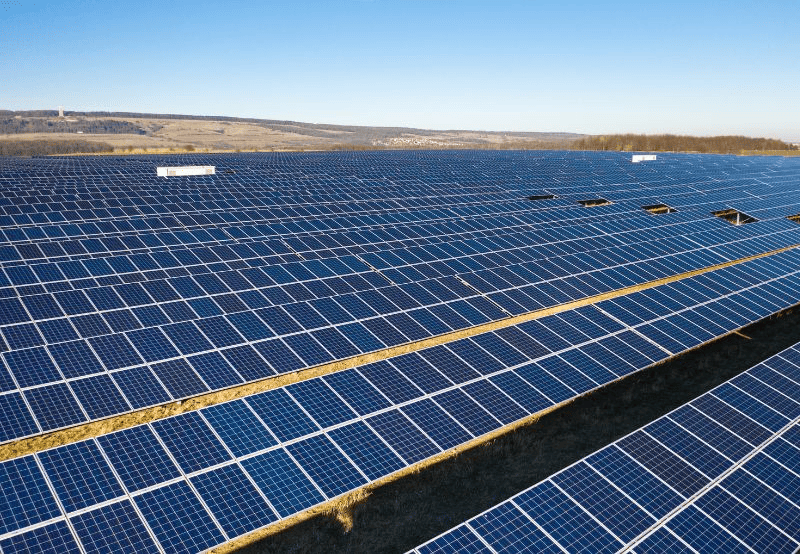
Rajasthan has made history in the clean energy journey of India as it became the first state in India where renewable sources provided over a half of electricity. The state has become the renewable energy giant in the country due to ample sunshine, large expanses of desert and aggressive government policies.
The renewable energy mix of Rajasthan is dominated by solar power, then wind, biomass. The state has more than 300 sunny days annually, and this fact places the state as one of the most suitable places in the world to generate solar energy. Districts like Jaisalmer, Jodhpur, Bikaner and Barmer have been able to supply the land to install some of the biggest solar projects in the world.
Read More:
Explore how India plans to transform sectors like energy, transport, industry, and urban development en route to its net-zero goal. Read the full article on India’s comprehensive roadmap here: Click here.
Installed Capacity
As of mid-2025, Rajasthan’s installed renewable capacity has crossed 45 GW, giving it the highest renewable capacity among Indian states. Solar alone makes up the lion’s share of this capacity.
Some of the landmark projects include:
- Bhadla Solar Park (2,245 MW) - the biggest solar park in the whole world, at Jodhpur district.
- Hybrid Renewable Parks - solar and wind to make sure that there is better capacity utilization and continuous power.
- Decentralized Solar Systems - increasing use of solar plants on rooftops and small-scale locations in urban areas and towns.
This rapid expansion has helped Rajasthan set a global example in renewable deployment.
Read More:
Discover how villages are being transformed through innovative solar initiatives. Read the full article on the Hallimysuru Model Solar Village Programme: Click here.
Tackling Intermittency: Storage Investments
While the growth of solar and wind has been impressive, the state faces the challenge of intermittency—solar power is unavailable at night, and wind is variable. To address this, Rajasthan has launched an ambitious plan to develop large-scale Battery Energy Storage Systems (BESS).
Storage Roadmap:
- 3,000 MW (3 GW) of battery storage projects are currently under active development.
- An additional 2,000 MW (2 GW) is in the planning stage.
This will give Rajasthan a total of 5 GW of storage capacity, placing it at the forefront of grid-scale storage in India.
Benefits of Storage:
- Ensures round-the-clock renewable power (RTC).
- Balances the grid and reduces power blackouts.
- Reduction in wastage of solar/wind energy at low-demand hours.
- Provides constant, clean energy to industries, homes and businesses.
Policy & Institutional Support
The state government in collaboration with the Ministry of New and Renewable Energy (MNRE) and the Solar Energy Corporation of India (SECI) is in the process of implementing storage-linked renewable tenders. Large-scale independent developers, including Adani Green, ReNew Power and NTPC Green Energy are pouring significant funds into solar, wind, and battery-hybrid developments.
Such a public-private alliance (PPP) strategy is making sure that Rajasthan remains the leader in the scale and innovation.
National Significance
Rajasthan is nearly a quarter of the total Indian solar capacity, so it is at the heart of a 500 GW renewable energy goal in India by 2030. As storage projects are developed, Rajasthan will be the first state to be able to provide firm, reliable renewable power at scale.
By becoming successful, not only will India have an improved energy security, but will be able to increase the pace of the country towards its net-zero objectives.
Conclusion
The fact that Rajasthan is generating more than 50 percent of its power through renewables indeed is a landmark in the Indian energy narrative. The state is building a model of the future whereby clean energy is not only abundant but also, dependable and sustainable by building large wind and solar installations with large battery storage projects.
The state has proven that with just the right combination of natural resources, support from government policy, and, technological advance, India's transition away from a fossil fuel based economy to one that is driven by renewables is not just plausible, but already in play.

